Rameshwaram

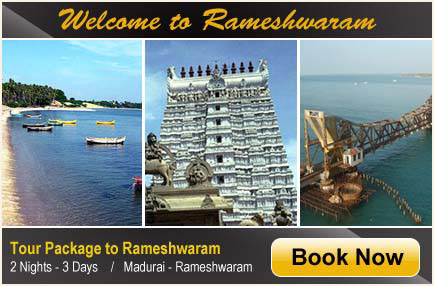
| Location : | Island Of Rameshwaram, Tamil Nadu |
| Deity Worshipped: | Linga Of Sri Ranganatha |
| Famous Tradition: | A Pilgrimage To Kashi Is Not Considered Complete Without A Pilgrimage To Rameshwaram |
| Significance: | One Of The 12 Jyotirlingas Of India |
| How to reach Rameshwarm | (Flights to Rameshwaram / Rameshwaram By Train / By Road) |
Rameshwaram is an island situated in the gulf of manner at the very tip of the Indian peninsula. A very important pilgrim centre of the Indians. Rameshwaram is the place from where Lord
Rama, built a bridge across the sea to rescue his consort Sita, from her abductor, Ravana. This is also the place where Rama worshipped Lord Shiva to cleanse away the sin of killing Ravana. Both the Vaishnavites and Shaivites visit this pilgrimage which is known as the Varanasi the south.
Visiting Rameshwaram is significant for the Hindus as a pilgrimage to Benaras is incomplete without a Pilgrimage to Rameshwaram. The presiding deity is the Linga Of Sri Ranganatha, which happens to be one of the twelve Jyotirlingas of India. Rameshwaram is also popularly referred to as the 'Benaras of the south'. In order to attain Moksha it is believed that the visit to Rameshwaram is mandatory.
Booking Information/Reservation
User Review
 Kathy
KathyUnited States:
""We had traveled to Rameshwaram before fifteen days.I want to thank your entire team for organizing our trip to Rameshwaram which was an eye opener, visit to Ramanathaswamy temple - was truly a divine experience & the beach of Rameshwaram with rare sea species and coral reefs is a feast for the eyes. I look forward to using your services in the future"
Mythological History
According to the Hindu mythology i.e. the story of Ramayana Lord Rama performed thanksgiving rituals to Lord Rama after the battle at Sri Lanka and his triumph over the demon king Ravana. Owing to this Rameshwaram attracts Vaishnavites (worshippers of Lord Vishnu) and Saivites (worshippers of Lord Shiva) alike.Sri Lanka is at a distance of 24 kilometers from Rameshwaram. In fact the entire area of Rameshwaram is associated with various incidents from the Ramayana. Rameshwaram happens to one of the most visited pilgrim sites in India.
Rameshwaram Jyotirlinga
Rameshwaram Jyotirlinga of Lord Shiva is situated on the peninsular tip Rameshwaram. It was Lord Rama who installed this Linga there, when he was on his way to attack Ravana he reached this place where he made a linga of sand and worshipped it. It was also believed that when Lord Rama was drinking water on the seashore there was a celestial proclamation - 'You are drinking water without worshipping me'.
Location and Area
The religious island is spread in an area of 61.8 square kilometers and happens to be in the shape of a conch. The Ramanatha Swamy Temple occupies major area of Rameshwaram.
Rameshwaram Tour Packages - Discount Available
Duration: 2 nights and 3 Days
Attractions: - Madurai Temple Tour
- Pilgrimage travel to Rameshwaram
- Enjoying the beach activities at Rameshwaram
Pilgrimage Tour Package to Rameshwaram
Duration: 11 nights and 12 Days
Attractions: - Travel to Chennai
- An excursion to Tirupati Balaji Temple
- Visiting Natraja Temple at Mammalapuram
- An excursion to Thanjuvaur
- Visiting Rameshwaram
- Travel to the holy town of Kanyakumari
The masterpiece of Dravidian architecture boasts
of the largest temple corridor in India. Different rulers built the
Ramanatha Swamy Temple over a period of time starting from the 12th century.
The temple comprises of twenty-two wells where the taste of the water of
each well is different from the other. Duration: 2 nights and 3 Days
Attractions: - Madurai Temple Tour
- Pilgrimage travel to Rameshwaram
- Enjoying the beach activities at Rameshwaram
Pilgrimage Tour Package to Rameshwaram
Duration: 11 nights and 12 Days
Attractions: - Travel to Chennai
- An excursion to Tirupati Balaji Temple
- Visiting Natraja Temple at Mammalapuram
- An excursion to Thanjuvaur
- Visiting Rameshwaram
- Travel to the holy town of Kanyakumari
Pilgrimage Attaractions of Rameshwaram
- Ramanathaswamy Temple
Ramnathswamy temple was built in the 17th century. Situated close to the sea on the eastern side of the island, this temple is famous for its 1200 gigantic granite columns. The 54 metre tall gopuram (gate-tower), 1220 metres of magnificent corridors and the flamboyant columns embellish and render fame to the temple. The water in each of the 22 sacred wells in the temple tastes different. - Agnitheertham
100 metres away from the temple is Agnitheertham, where Rama worshipped Lord Shiva, to absolve himself from the killing Ravana. - Gandamadana Parvatham
The imprint of Lord Rama's feet placed on a Chakra (wheel) is found in this shrine which is at the highest point on the island at 2 km from Rameswaram. - Dhanushkodi
Dhanushkodi named after Rama's bow, is at the eastern end of the island at a distance of 8 kms from Rameshwaram. The boulders around the sea between Srilanka and this place known as Adam's bridge, are believed to be used by Hanuman to reach across Srilanka. Dhhanushkodi was completely destroyed by the cyclones of 1964. Kothandaramaswamy temple is the only salvage of the cyclone. Idols of Rama, Sita, Lakshmana, Hanuman and Vibhishana (brother of Ravana), surrendered to Rama, here. - Erwadi
An important site for Muslim pilgrims, Erwadi houses the tomb of Ibrahim Sahid Aulia. At a distance of 24 kilometers from Rameshwaram is Erwadi. Muslims from across the globe visit Erwadi especially during the month of December to participate in the annual festival celebrated as a tribute to the saint.
- Ramanathapuram
This ancient town is the district headquarters. The Ram Vilas Palace of the Sethupati Rajas is a must visit place. The oil portraits of the Rajas of the past centuries and the articulately designed ceilings and walls embellished with eighteenth century murals, the subjects of which vary from business. Meetings with the English to battles with the Marathas, make this place more interesting. Donot forget to take Rameshwaram temple photos. - Tirupullani
Outside the island, there are three other sites traditionally connected with Sri Rama's expedition to Sri Lanka. A big temple in Tiruppullani commemorates the tradition that there the Lord obtained a bow and arrows to use in the impending war from its presiding Deity and also that the Lord of the Ocean who had refused to help Him finally submitted. - Uthirakosamangai
16-km southwest of Ramanathapuram stands the renowed Shiva temple of Uttarakosamangai. Manikkavachagar has sung of it. The Lord is Mangaleshvara and the Goddess Mangalesvari. The temple has inspired many Tamil works of devotion. So, of course, has the Ramanatha Rameshwaram Temple. - Sethu
5-km south of the temple is Sethu, where there is a celebrated temple of Sri Anjaneya, and where, tradition holds, Sri Rama built a bridge to Sri Lanka. In Devipatnam, or Navapashanam, also by the sea, there are nine stones visible at low tide. It is believed that they were set up by Sri Rama to represent the nine planets, the Navagrahas.
Come along with us and explore the architectural beauty of temples at Rameshawaram:
Ramanathswamy temple built in 17th century and is popular for its 1200 gigantic columns, the 54 meters gate tower and also 1220 meters of magnificent corridors represents the architectural beauty of the temple.
Explore the adventure of Beach Activities at Rameshwaram:
The beach at Rameshwaram is clam and quite and very rare sea species and coral reefs. There are many remarkable variety of marine species like algae, starfish, sea cucumber, crabs, sponges and sea cow are found here. Travelers can even enjoy the sight of dolphins. Tourists can get involved in swimming, sun bathing and also enjoy the sights of frolic dolphins.
Can also opt for Sightseeing at Rameshwaram:
Most of the people prefers to organize picnic at Rameshwaram. The majestic beaches of Dhanushkodi, Olaikuda, and Pamban are the most wonderful sights to organize the picnics. The Olaikuda beach is located at the distance of 1 kilometer from the main temple. Its the beach that is the best for bathing.
There's something Nature lovers also:
Rameshwaram is the paradise for the nature lovers. Most favorite tourist activity in Rameshwaram is the Bird watching. Different variety of birds like Sea Gulls and Australian Flamingos which flies during the winters. The place is having different color, shapes and sizes. The chirping of these birds are also very much popular at Rameshwaram.
About Rameshwaram Shopping:
Shopping for south silk sarees and Kanjiveeraum are the must buy things in Rameshwaram.
Reaching Rameshwaram:
Madurai Jn (MDU) is a nearby train station connected to Mumbai
How to reach rameshwaram from pondicherry
Distance from Pondicherry to Rameswaram is 435 Kilometers / 270 Miles.
Trivandrum to rameswaram distance
Trivandrum (Kerala) to Rameswaram (Tamil Nadu) is 401 km and takes approx 7 hrs, 27 mins by road.
Trichy to Rameswaram distance
Distance from Tiruchirapalli to Rameswaram is 240 km. And Drive from Tiruchirapalli to Rameswaram takes about 4.8 hours by car.
Tirunelveli to Rameswaram Tour distance
Tirunelveli (Tamil Nadu) to Rameswaram (Tamil Nadu) is 252 km and takes approx 5 hrs, 10 mins by road.
Rameswaram to Madurai
Distance from Madurai to Rameswaram is 173 km. And Drive from Madurai to Rameswaram takes about 3.46 hours by car.
Chennai to Rameshwaram
Distance from Chennai to Rameswaram is 571 km. And Drive from Chennai to Rameswaram takes about 11.42 hours by car.
Rameshwaram to Kanyakumari
Rameswaram (Tamil Nadu) to Kanyakumari (Tamil Nadu) is 325 km and takes approx 6 hrs, 24 mins by road.
How to reach rameshwaram from tirupati
Tirupati (Andhra Pradesh) to Rameswaram Tamil Nadu India is 737 km and takes approx 13 hrs, 30 mins by train.
How to reach rameshwaram from delhi
Services available by Road/Train and Flight
How to reach rameshwaram from pune
Services available by Road/Train and Flight
Rameshwaram Temple Timings
5.00 am- Palliyarai (Sayanagruha) Deeparadhana
5.10 am - Saptika linga Deeparadhana
5.45 am -Thiruvananthal Deeparadhana
7.00 am -Vila Puja
10.00 am -Kaalasanthi Puja
12.00 noon -Uchikala Puja
6.00 pm -Saayaraksha Puja
8.30 pm -Ardhajaama Puja
8.45 pm -Palliyarai Puja
Booking Information/Reservation
| Related Links |
| About Rameshwaram Tours Rameshwram To Kanyakumari South India Temple Tour |
South India Religious Tours South India Ancient Tour South India Festival Tour |
Booking Information/Reservation
|
Related Tour
Packages
|
Home
| About Us | Contact
Us | Agents |
Tour Booking |
Car/Coach Rentals |
Hotel Booking | Feedback
Copyright © 2009 Pilgrimage India.
Copyright © 2009 Pilgrimage India.
