
| Location : | Bihar |
| Famous for: | Buddhist Pilgrimage |
| Related Links: | Bodhi Temple, Maha Bodhi Temple |
Bodhgaya Temple
This is where Prince Gautama attained enlightenment under the sacred Asvatta tree (Bodhi tree) and became known as Lord Budha. This is one of the four most sacred pilgrimage places for the Buddhists. The other three important places are his place of birth at Lumbini, Nepal; the site of his first lecture at Sarnath, near Varanasi; and the place where he left his body at Kushinagar, near Gorakhpur. Buddhists from all over the world have built temples here in Bodh Gaya (also called Bodhi Gaya). The Dalai Lama often spends time here. Tibetan pilgrims come here for the winter from Dharamshala. Bodh Gaya is located about 13 km from Gaya, 450 km west of Calcutta, and 90 km south of Patna.
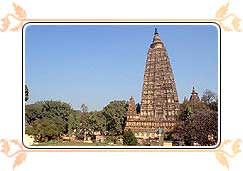
Bodh Gaya is a place which should be visited or seen by a person of devotion and which would cause awareness of the nature of impermanence.
Siddhartha Gautama, the Buddha-to-be, had been dwelling on the banks of the Nairanjana River with five ascetic followers for six years practicing austerities. Realising that austerities could not lead to realisation he abandoned them. His five ascetic companions disgusted at his seeming failure, deserted him and left for Sarnath.
Bodhgaya Tour
Location of Bodhgaya
Gaya is located at a distance of 105 km from Patna in the state of Bihar. Buddha Gaya is located 7 miles south of Gaya and is one of the well visited Buddhist pilgrimage centers of the Indian subcontinent.
Bodh Gaya Pilgrimage
Attractions
- Mahabodhi
Temple
The Mahabodhi Temble is located at the place of Lord Buddha's enlightenment. The temple has a 50m (170 ft) tower. The present temple was restored around 1880. There have been several other temples on this site. A previous temple was destroyed by the Muslims in the 11th century. Parts of the intricately carved railings to the south and west of the temple are very old. Some of the railings are original and parts of the railings are reproductions.
In the inner sanctuary there is a huge Buddha statue. In the center of the temple there is also a Siva-linga that was installed about 860. This temple is also sacred to the Hindus because Lord Buddha is the ninth incarnation of Lord Vishnu. - Bodhi Tree
The Bodhi tree or Bodh Gaya tree here is said to be a descendent of the tree under which Budhha attained enlightenment. A sapling of the original bodhi tree that the Buddha sat under was carried by Emperor Ashoka's daughter (Sanghamitta) to Sri Lanka. That tree is at Anuradhapura in Sri Lanka. A cutting from that tree was planted in Bodh Gaya when the original tree died. Under the tree is a red sandstone slab that is said to be the Vajrasana, the diamond throne, that Bodhgaya Buddha sat on and attained nirvana. The tree is located behind the temple and is about 80 feet high and about 115 years old. - Vajrasana
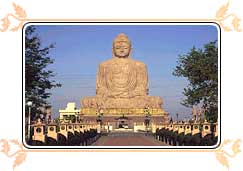 Vajrasana,
the seat of stability. Buddha supposed to have say in meditation
gazing east, under the Bodhi Tree, where the Vajrasana, the stone
platform is kept.
Vajrasana,
the seat of stability. Buddha supposed to have say in meditation
gazing east, under the Bodhi Tree, where the Vajrasana, the stone
platform is kept. - Chankaramana
This marks the sacred spot of the Buddha's meditative perambulations during the third week after pious enlightenment. It is believed that wherever the Buddha put his feet lotus sprang up. - Arimeshlochana
It is believed that the Buddha spent one week here looking towards the great Mahabodhi Tree out of gratitude, without twinkling his eyes. - Ratnagar
The Buddha spent one week here, where it is believed that five colours came out of his body.