
Kanyakumari (also spelt as
Kanniyakumari) district is bounded by Tirunelveli district in the north and
northeast, by Kerala state in the northwest and confluence of Arabian Sea
and Indian Ocean in the west and south. The coastline is almost regular
except for some points of land projecting into the sea at Cape Comorin.
Kanyakumari is the district headquarters of the district of the same name.
At the southern most land tip of India, where the Arabian Sea, the Indian
Ocean and the Bay of Bengal meet, lies Kannyakumari, an important pilgrim
centre. Kannyakumari is famous for its beach and the spectacular sunrises
and sunsets, especially on full moon days. Kanyakumari is also famous for
its vast green stretches of paddy fields, rich forests, coconut groves and
mineral sands.
The Origin of Name
Kannyakumari has been named after the Goddess Kannyakumari Amman who is the
popular deity of the area. Legend has it that the Goddess Parvati in one of
her incarnations as Devi Kanniya did penance on one of the rocks of this
land's end to obtain the hand of Lord Shiva.
Location
Kanyakumari is the southern most district of Tamil Nadu. The district lies
between 77o 15' and 77o 36' of the eastern longitudes and 8o 03' and 8o 35'
of the northern Latitudes. The District is bound by Tirunelveli District on
the North and the east. The South Eastern boundary is the Gulf of Mannar. On
the South and the South West, the boundaries are the Indian Ocean and the
Arabian Sea. On the West and North West it is bound by Kerala.
The History
Kanniyakumari district, once known as "The Granary of Travancore"
lies at the southwestern part of Indian peninsula. It was in Travancore for
a long time and then merged with Tamil Nadu in 1956 under the State
Linguistic Reorganisation Act.
At the southernmost tip of India, where the Arabian Sea, the Indian Ocean
and the Bay of Bengal meet, lies Kanyakumari, an important pilgrimage site.
The Kumari Amman temple, here, is dedicated to Parvati as Devi - Kanya - the
virgin goddess who did penance to obtain the hand of Lord Shiva.
Two rocks reach out of the ocean, south-east of the Kumari Amman temple.
One of these is Sri Padaparai, where the footprints of the virgin goddess
are to be seen. On this rock, Swami Vivekananda is said to have sat in deep
meditation; and here stands the Vivekananda Rock Memorial, built in 1970.
Pilgrimage
Attractions of Kanyakumari
- Temple Of Goddess Bhagavathi
Few temples in India are more picturesquely located than that of
Goddess Bhagavathi in Kannyakumari. It stands near where three
oceans meet: the Indian Ocean, the Bay of Bengal and the Arabian
Sea.
In its early form the temple seems to have been built by the first
Pandyas. The Nayaks expanded it later. There are three Prakaras. The
image of the Goddess in the sanctum is marvellous in its serenity
and beneficence. She carries a necklace in Her right hand. The
eastern gate, facing the Bay of Bengal is opened only five times a
year.
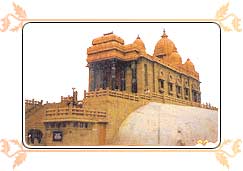
- Swami Vivekananda Rock Memorial
On the evening of December 25, 1892, Swami Vivekananda who had come
to Kannyakumari on pilgrimage swam to the rock and spent the whole
night there in deep meditation. He then resolved to decide himself
to the service of the Motherland and to spread the message of
Vedanta. Next year he attended the Parliament of Religions in
Chicago, an event of seminal importance in the modern history of
Hinduism. To commemorate his visit to the rock a superb memorial has
been erected. It attracts thousands of visitors.
- The Temple at Suchindram
Tradition connects the Kannyakumari temple with that in Suchindram
(13-km from Kanyakumari). This is a fine, large fane, with a
beautiful tank. It is one of the few temples in the country where
the Trinity, Brahma, Vishnu and Isvara, are worshipped. The Linga,
named "Sthanumalaya", is in three parts; the top
represents Lord Shiva, the middle Lord Vishnu, and the base Lord
Brahma. "Sthanu" is a name of Shiva, "Mal" of
Vishnu, and "Ayan" of Brahma.
- Kumari Amman Temple
Picturesquely situated overlooking the shore, this temple and the
nearby ghat attract pilgrims from all over India to worship and to
bathe. according to legend, Devi did penance here to secure siva's
hand in marriage. when she was unsuccessful, she vowed to remain a
virgin (kanya). The temple is open daily from 4.30 to 11.45 am and
from 5.30 to 8.30 pm, but non-Hindus are not allowed into the inner
sanctrum. Men must remove their shirts, and everyone their shoes on
entering the temple.
- Nagaraja Temple at Nagercoil
19-km from Kannyakumari is Nagercoil, which contains the celebrated
Nagaraja temple. The sanctum is a simple thatched shed, with mud
walls. It enshrines the King of Serpents. Tradition states that a
King of Kalakkad was cured of leprosy when he performed penance in
the temple. He then rebuilt it in the Kerala style. He might have
been Bhuthalavira Sri Vira Udaya Marthandavarma, who ruled Venad,
with Kalakkad as his capital, from 1516 to 1535. It is believed that
snakebite is not fatal within a kilometre of the temple. The fane
has some Jain sculptures.
- Tirunelveli
The temple of Swami Nelliappar and Sri Kanthimathi Ambal in
Tirunelveli (83-km from Kanyakumari) dates back at least to the
seventh century. Sambandar has sung it, and Ninrasir Neumaran, the
Pandya, is said to have commissioned the making of musical pillars
in a Mandapa in this temple. Originally, there were two temples side
by side, dedicated to Lord Nelliappar and Goddess Kanthimathi. They
were linked by a Mandapa, the "chain" Mandapa, built in
1647. The oldest inscription belongs to the middle of the tenth
century.
- Sankaranainarkoil
Sankaranainarkoil has three shrines dedicated to Lord Sankaralinga,
to Goddess Gomathi Amman and, between these two, to Lord
Sankaranarayana, a combination of Shiva and Vishnu. The temple was
built in the eleventh century and was expanded later. The Gopura is
of nine storeys and is 38m high. The temple is famous for the
miracles the Goddess performs in curing illness.
- Subramanya Temple in Tiruchendur
The temple of Lord Subramanya in Tiruchendur, also in the same
district, is one of the "Arupadai Veedus", or specially
sanctified residences, of the Lord. It is situated by the sea.
Traditionally, it commemorates the Lord's victory over Surapadma, a
demon. The Gopura, of nine storeys, is 42m high and was constructed
in the 17th century. It was renovated in 1983.
- Kumarakovil
Kumarakovil is at the foot of the Velimalai hills in Kalkulam Taluk
(also spelt as Taluka), about 34-km from Kannyakumari. The Lord
Muruga Temple is built on the hillock about 200 feet height in a
lush green field of Paddy, Plantain and Coconut trees. The temple is
noted for architectural beauty. Goddess Valli, the spouse of Lord
Subramanya is also enshrined in the temple by the side of the Lord.
In the right side of the temple there is one big lake, suitable for
boating.
|