
The Jain Dilwara temples of
India are located about 2½ kilometers from Mount Abu, Rajasthan's only
hill station. These temples dating back from the 11th to the 13th century AD
are world famous for their stunning use of marble. The five legendary marble
temples of Dilwara are the sacred pilgrimage of the Jains. They are an
overwhelming blend of simple beauty and exquisite elegance. The marble
temples have an opulent entranceway. The simplicity in architecture verily
reminds one that Jainism as a religion "encouraged honesty and
frugality". The temples reside amidst mesmerizing surroundings of mango
trees and wooded hills. A high wall, shimmering luminous in the sunlight,
shrouds the temple complex.
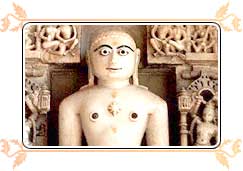
Although the Jains built some beautiful temples at other places in
Rajasthan but none come close to these in terms of architectural perfection.
The ornamental detail spread over the minutely carved ceilings, doorways,
pillars and panels is simply marvellous and has to be seen to be believed.
Five Unique Temples of Dilwara
There are 5 temples in all, each with its own unique identity though
together they are named after the small village in which they are located.
These are:
- Vimal Vasahi Temple
This temple carved entirely out of white marble was built in 1021
AD by Vimal Shah, a minister of Raja Bhimdeo. The temple is
dedicated to the 1st Jain Tirthankara (teacher or guide) Adi Nath.
The temple stands in an open courtyard surrounded by a corridor,
which has numerous cells containing smaller idols of the
Tiranthakaras. The richly carved corridors, pillars, arches, and
'mandaps' or porticoes of the temple are simply amazing. The
ceilings feature engraved designs of lotus-buds, petals, flowers and
scenes from Jain and Hindu mythology.
The Rang mandap is a grand hall supported by 12 decorated pillars
and nicely carved out arches with a breathtaking central dome. On
the pillars are carved female figurines playing musical instruments
and 16 Vidhyadevis or the goddesses of knowledge each one holding
her own symbol.
The Navchowki is a collection of nine rectangular ceilings, each
one containing beautiful carvings of different designs supported on
ornate pillars. The Gudh mandap is a simple hall once you step
inside its heavily decorated doorway. Installed here is the idol of
Adi Nath or Lord Rishabdev, as he is also known. The mandap is meant
for 'Arti' to the deity. The Hastishala (Elephant Cell) was
constructed by Prithvipal, a descendant of Vimal Shah in 1147-49 A.D
and features a row of elephants in sculpture.
- Luna Vasahi (Shri Nemi Nathji
temple)
The Luna Vashi temple is dedicated to the 22nd Tirthankara Shri
Nemi Nathji. This magnificent temple was built in 1230 AD by two
brothers - Vastupal and Tejpal - both ministers of a local ruler.
The temple built in memory of their late brother Luna was designed
after the Vimal Vashi temple. The main hall or Rang mandap features
a central dome from which hangs a big ornamental pendent featuring
elaborate carving. Arranged in a circular band are 72 figures of
Tirthankaras in sitting posture and just below this band are 360
small figures of Jain monks in another circular band. The Hathishala
or elephant cell features 10 beautiful marble elephants neatly
polished and realistically modelled.
The Navchowki features some of the most magnificent and delicate
marble stone cutting work of the temple. Each of the nine ceilings
here seems to exceed the others in beauty and grace. The Gudh mandap
features a black marble idol of the 22nd Jain Tirthankara Neminath.
The Kirthi Stambha is a big black stone pillar that stands on the
left side of the temple. The pillar was constructed by Maharana
Kumbha of Mewar. The remaining three temples of Dilwara are smaller
but just as elegant as the other two.
- Pittalhar Temple
This temple was build by Bhima Shah, a minister of Sultan Begada of
Ahmedabd. A massive metal statue of Rishab Dev (Adinath), cast in
five metals is installed in the temple. The main metal used in this
statue is 'Pital' (brass), hence the name 'Pittalhar'. The Shrine
consists of a main Garbhagraha, Gudh mandap and Navchowki.
- Parshavanath Temple
This temple, dedicated to Lord Parshavnath was built by Mandlik and
his family in 1458-59 A.D. It consists of a three storied building,
the tallest of all the shrines at Dilwara. On all the four faces of
the sanctum on the ground floor are four big mandaps. The outer
walls of the sanctum comprise of beautiful sculptures in gray
sandstone, depicting Dikpals, Vidhyadevis, Yakshinis, Shalabhanjikas
and other decorative sculptures comparable to the ones in Khajuraho
and Konark.
- Mahaveer Swami Temple
This is a small structure constructed in 1582 A.D. and dedicated to
the 24th Jain Tirthankara, Lord Mahaveer. There are pictures on the
upper walls of the porch painted in 1764 A.D. by the artists of
Sirohi.
|