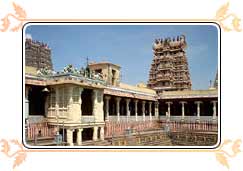
No text can do justice to the
Meenakshi temple. The gigantic temple complex, the statues exploring the
entire range of human emotions, everything here is larger than life. The
Meenakshi temple complex is a city temple - one of the largest and certainly
one of the most ancient. According to legend Madurai is the actual site
where the wedding between Shiva and Meenakshi took place. The soaring and
exquisitely carved towers enclose the temple dedicated to Meenakashi. The
south gateway contains the twin temples of Shiva and Meenakshi and is about
nine storeys high.
The
Origin Of The Meenakshi Temple
The Sri Meenakshi Sundareswara temple and Madurai city originated together.
According to tradition, Indra once committed sin when he killed a demon, who
was then performing penance. He could find no relief from remorse in his own
kingdom. He came down to earth. While passing through a forest of Kadamba
trees in Pandya land, he felt relieved of his burden. His servitors told him
that there was a Shivalinga under a Kadamba tree and beside a lake. Certain
that it was the Linga that had helped him; he worshipped it and built a
small temple around it. It is believed that it is this Linga, which is till
under worship in the Madurai temple. The shrine is called the "Indra
Vimana".
Once Dhananjaya, a merchant of Manavur, where the Pandyas had arrived after
the second deluge in Kumari Kandam, having been overtaken by nightfall in
Kadamba forest, spent the night in the Indra Vimana. When next morning he
woke up, he was surprised to see signs of worship. Thinking that it must be
the work of the Devas, he told the Pandya, Kulasekhara, in Manavur, of this.
Meanwhile Lord Shiva had instructed Pandya in a dream to build a temple and
a city at the spot Dhananjaya would indicate. Kulasekhara did so. Thus
originated the temple and city.
Earliest References Of The Temple
Paranjothi Munivar wrote the Tiruviayadal Puranam in the sixteenth century.
It is regarded as the temple's Sthalapurana. An earlier work adds a few
celestial sports not included in the latter. These are, or rather were
painted on the walls around the Golden Lily Tank. Some of the painted wooden
panels are in the Temple Museum.
The earliest references available to any structure in this temple is a hymn
of Sambhandar's, in the seventh century, which refers to the "Kapali
Madil". The present inner walls of the Lords shrine bear this name
today. In the early times the entire temple must have been confined to the
area between these walls, and the structures must have been of brick and
mortar.
In the 14th century an invasion by Malik Kafur damaged the temple. In the
same century Madurai was under Muslim rule for nearly fifty years. The
temple authorities closed the sanctum, covered up the Linga, and set up
another in the Ardhamandapa. When the city was liberated, the sanctum was
opened, and, tradition says the flower garlands and the sandalwood paste
placed on the Linga were as fresh as on the first day, and two oil lamps
were still burning.
- Ashta Sakthi Mandapa
It is a convention in this temple, different from that followed in
others, that the devotee offers worship first to Goddess Meenakshi.
Therefore, while there are four other entrances into the temple,
under huge Gopuras in the four cardinal directions, it is customary
to enter not through any of them but through a Mandapa, with no
tower above it. This entrance leads directly to the shrine of the
Goddess.
This Mandapa is an impressive structure, with a hemispherical
ceiling. It is 14m long and 5.5m wide. There are bas-reliefs all
over the place. Over the entrance one of them depicts the marriage
of Goddess Meenakshi with Lord Somasundara. The Mandapa derives its
name, the "Ashta Sakthi", from the fact it contains
sculptures of the eight Sakthis (also spelt as Shakti). Those of the
four principal Nyanmars were added during renovation of the temple
in 1960-63.
- Samagam Meenakshi Naicker Mandapa
A smaller Mandapa connects the large one with another large one
with another large hall, called the "Samagam Meenakshi Naicker
Mandapa", after its builder, a minister of Vijayaranga
Chokkanatha (1706-32), who erected in 1707. In former times the
temple's elephants camels and bulls used to be stabled here. A brass
"Tiruvatchi" holding a thousand and eight lamps stands
here, 7.6m high. Marudu Pandya, one of the early opponents of the
growing British power, installed it.
The Meenakshi Naicker Mandapa is a huge hall, 42.9m long and 33.5m
wide. It contains 110 stone columns, each 6.7m high. There are yalis
in the capital and delicate reliefs below. Some of the carvings are
unfinished.
- Mudali Pillai Mandapa
The Mudali Pillai Mandapa follows the Chitra Gopura. Added in 1613,
it is 183m long and 7.6m wide. On its wall are many puranic scenes.
It used to be without any natural light, but windows were added in
the last renovation.
The
Golden Lily Tank
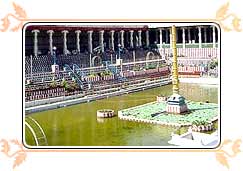
The lovely and historic Golden Lily tank then comes into view. It
is from its banks that most popular photographic views of the temple
are taken, showing the gigantic south outer Gopura. The northern
corridor leads directly to the shrine of the Goddess. On its pillars
are the images of some of the Sangam poets, of Kulasekhara Pandya,
the first builder of the temple, and of Dhananjaya, who figures in
the traditional story of its origin. There is no fish in the tank.
The corridors around the tank are rightly called the "Chitra
Mandapa", for the walls carry paintings of the divine sports of
the Lord, as narrated in the "Tiruvilayadal Puranam". They
have been renewed from time to time. A short while ago there were
paintings on wooden panels affixed over an older series. They have
since been removed to the Temple Museum in the thousand-pillared
Mandapa, leaving some dilapidated murals to view. It is impossible
to ascertain the date of these.
It was in the sixteenth century that the corridors and the steps
leading down to the tank were constructed; the northern corridor and
steps in 1562, those on the east in 1573, and those on the south
five years later.
- The Unjal And Kilikatti Mandapas
Two Mandapas, the Unjal and the Kilikatti, stand on the farther way
to the shrine of the Goddess. On their ceilings are more paintings.
A celebrated mural, opposite to the entrance of the shrine, depicts
the marriage of Goddess Meenakshi. The Kilikatti Mandapa derives its
name from the fact that there are parrots in a cage here. On its
walls are carvings of the divine sports. The most ornamental of the
temple's Mandapas, it was built in 1623.
A Gopura of three tiers stands over the entrance from this Mandapa
into the shrine of the Goddess. Built in 1227 by Vambathura Ananda
Tandava Nambi, it is named the Vambuthurar Gopura after him. The
shrine consists of a square sanctum, an Ardhamandapa and a
Mukhamandapa. In the niches on the walls of the shrine are images of
Iccasakthi in the south, Kriyasakthi in the west, and Jnanasakthi in
the north. There are shrines of Vinayaka and Subramanya in the outer
Prakara. They probably belong to the fifteenth century.
- The Historic Shrines In The Prakaras
There are a number of historic shrines in the Prakaras. Opposite to
an entrance into the first from the Mahamandapa there is one of Lord
Sabhapathi. This is the famous Velliambalam where one of the Lord's
divine sports took place when, at the request of the sages,
Patanjali and Vyagrapadha, He danced as Lord Nataraja.
In the second Prakara a shrine, now called that of the Sangam
poets, contains images of many of them. In the same Prakara there is
a shrine apparently dedicated to Kariyamanikka Perumal, but now
empty. Also in the same Prakara there is a row of fourteen small
shrines, called the "isvarams". Many of them contain
Lingas.
|