
| Area : | 6.0 sq km |
| Population : | 13,860 (1991) |
| Languages : | Hindi and English |
| Best time to visit : | October to April |
Kushinagar, one of the principal centers of Buddhist pilgrimage is the place of Mahaparinrvana. The monument of Kushinagar are situated in three distinct comprising in the main site of the Nirvana Temple houses over 6meter long statue of the reclining Buddha The image was unearthed during the excavations in 1876. An inscription below dates the statue to the 5th century BC Mathakaur shrine is black stone image of Lord Buddha in the Bhumi Sparsha Mudra (a posture showing him touching the earth ) was recovered here.
The credit for bringing this ancient site to light goes to General A. Cunningham and A.C.I. Carlyl, who, after excavating the site in 1861, established its antiquity for the first time. Later, between 1904 and 1912, several excavations conducted by the Archaeological Survey of India at Kushinagar confirmed its identity.
Location of Kushi Nagar
Kushinagara is situated in the north Indian state of Uttar Pradesh, 51 km off Gorakhpur. The place, which is famous for the Mahaparinirvana (death) of Lord Buddha, has been included in the famous Buddhist trail encompassing Bihar, Uttar Pradesh, and Nepal.
Kushinagar History
Kushinagar is also known as Kasia or Kusinara. The founder of Buddhism, Lord Buddha passed away at this place near the Hiranyavati River and was cremated at the Ramabhar stupa. It was once a celebrated center of the Malla kingdom. Many of Kushinagar temples, stupas and viharas date back to 230 BC-AD 413. when its prosperity was at the peak. The Mauryan emperor Ashoka added grandeur to this place by getting the magnificent statue of Buddha carved on a single piece of red sandstone. Fa Hien, Huen Tsang, and I-tsing, the three famous Chinese scholar travelers to India, all visited Kushinagar or Kushinagara.
With the decline of Buddhism, however, Kushinagar lost its importance and suffered much neglect. It was only in the last century that Lord Alexander Cunningham excavated many important remnants of the main site such as the Matha Kua and Ramabhar stupa and Kushinagar news made headlines. Today, people from all over the world visit Kushinagar. Many national and international societies and groups have established their centers here.
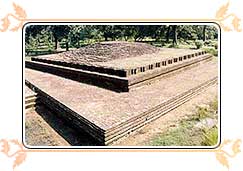 This
huge brickwork stupa, exposed by Carlleyl in 1867, stands at a
height of 2.74 meter. A copper vessel was unearthed at this site. It
bore an inscription in ancient Brahmi, which stated that Lord
Buddha's remains had been deposited here. The Stupa is located in
the east of the main Nirvana Temple.
This
huge brickwork stupa, exposed by Carlleyl in 1867, stands at a
height of 2.74 meter. A copper vessel was unearthed at this site. It
bore an inscription in ancient Brahmi, which stated that Lord
Buddha's remains had been deposited here. The Stupa is located in
the east of the main Nirvana Temple. 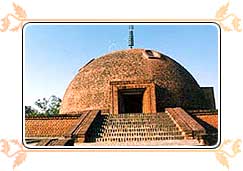 A
beautiful Ashta Dhatu (eight metlas) statue of Lord Buddha, which
came from Japan, can be seen here. Built by the Atago Isshin World
Buddhist Cultural Association, it consists of a single circular
chamber, housing a golden image of Buddha, softly lit through small,
stained-glass window.
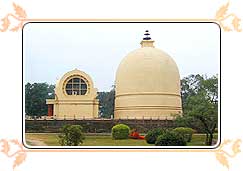
A
beautiful Ashta Dhatu (eight metlas) statue of Lord Buddha, which
came from Japan, can be seen here. Built by the Atago Isshin World
Buddhist Cultural Association, it consists of a single circular
chamber, housing a golden image of Buddha, softly lit through small,
stained-glass window.