
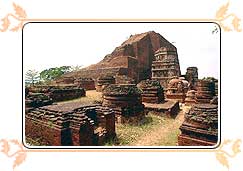
Nalanda - Visited
by the Buddha & site of the great Buddhist university

Another
trip from Rajgir is to Nalanda. This small village and its surrounding area
have numerous associations with the Buddha and his disciples. Sailo 3
kilometres south-west of Nalanda is where the Buddha met and converted Maha
Kassapa, the man who was later to become his successor. A large statue of
Kassapa with an inscription on it was found in the village in the early
1900's but unfortunately its whereabouts is now unknown. The village of Kul
some 1.5 kilometres south-east of Nalanda is the Kolita of old and the
birthplace of Moggalana, the second of the Buddha's two chief disciples.
Nalanda itself was often visited by the Buddha during his numerous sojourns
through Magadha and he taught several important discourses there.
History
In about the 5th century B.C. a monastic university was established at
Nalanda that was eventually to develop into the greatest ancient centre of
Buddhist learning. Students from China and Korea, Sri Lanka and Indonesia
and from all the regions of India came to Nalanda to study. When Hiuen
Tsiang was studying at Nalanda in the 7th century there were 1510 teachers
and 8500 students. The Tibetan pilgrim Dharmasvamin was here in 1234 and has
left an a gripping account of the monastery's destruction by the Muslims.
Attractions
of Nalanda
- Nalanda University
Established in the 5th century B.C., Nalanda is recorded as the
world's earliest university. Buddha is believed to have visited
Nalanda a number of times. His favourite disciple, Sariputra was
born here and he died preaching at this place. In the 3rd century
B.C., Mauryan Emperor Ashoka honoured the famous monk with a grand
stupa. Gradually, it became associated with the monks and scholars
gathered here for discourses and by 5th century B.C. it acquired the
position of a well established monastery under the Guptas.
Since the time of Buddha, the bhikkus were always encouraged to
study the various arts and sciences. Learning was greatly encouraged
as served dual proposes: knowledge and practice. The monks,
therefore took to learning so that they might practice it and
realise Dhamma perfectly and thereby enrich the masses. The old an
incapable were suggested to attach more importance to the practice
of meditation. Buddha is believed to have said that if a man live in
a Sangha for a few days only and observe the percepts described in
the Patimokha, his life would be more precious than his previous
one.
A long succession of kings from 5th to 12th century extended their
royal patronage to ensure the progress and prosperity of the
university. A copper plate inscription tells us about the erection
of a monastery by the king of Sumatra and records and grant of five
villages by the Pala Kings for the maintenance of the monastery at
the request of the foreign king.
Nalanda during its hey days was a flourishing residential
university with over 10,000 students and 1500 teachers. The
university was marked by a lofty wall and one gate. Hiuen Tsang, the
Chinese pilgrim spent three years at Nalanda. He has left a detailed
note about the university, its curriculum, activities and other
accounts. He describes about the tall Sangharana buildings which
were 3 to 6 storeys high. One of them was capped with a 80 ft. high
copper image of Buddha. Another Chinese pilgrim was I-Tsing, who
spent 10 years at this university and attests for 8 monastic
buildings and over 300 apartments.
Nalanda today is in ruins but still it imparts the scholarly look.
The archaeological zone here is classified into a number of sites
that include 11 monasteries and several temples built in red bricks.
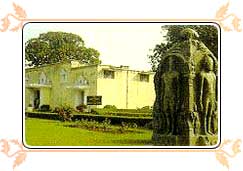
- The Nalanda Archaeological Museum
Opposite the entrance to the ruins of the university and houses, it
has a small but beautiful collection of Buddhist and Hindu bronzes
and a number of undamaged statues of the Lord Buddha that were found
in the area. Two enormous terracotta Jars of the first century stand
intact behind the museum in a shaded enclosure. The collection
includes copper plates and stone inscriptions, coins, pottery and
samples of burnt rice (12th century AD) found among the ruins here
- Nava Nalanda Mahavihara
Nava Nalanda Mahavihara is devoted to study and research in Pali
Literature and Buddhism. This is a new institute, where students
from foreign countries also study.
- Silao
In between Nalanda and Rajgir, there is a village namely Silao,
where a very popular local sweet "Khaja" is prepared.
- Surajpur Baragaon
The lake with its temple to Surya, the Sun god, is a pilgrim
destination twice a year in 'Vaishakha' (April-May) and in "Kartika"
(October-November), during the Chhath Puja or sun Worship.
|