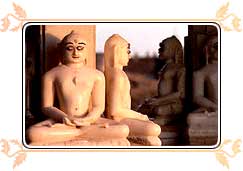
India is a land of spirituality
where great persons were born to sing immortal songs. The places stamped by
their holy feet became famous as sacred places. Idols of Tirthankara-
Parmatmas, promoters of Jainisim, were installed there. India has a large
number of such sacred places. They are powerful means of crossing the
samsara. They provide an opportunity to cure the disease of transmigration.
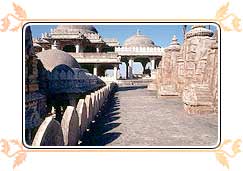
Sacred places are silent but they tell immortal stories of holy selfs of
Tirthankaras and other saintly beings . Picture writings and various kinds
of idols convey the message of Tirthankaras. The name of sacred places tells
glorious stories of its past history, its architecture, its culture,its
prosperity and the mind of the masses. Visits of monks and nuns preserve the
sacredness of sacred places. Sacred places are innocent places which are
free from worldly affairs. They who visit sacred places try to live an
innocent life. Sacred places remind us of the holy life of Tirthankaras.
Worthy people sing God's virtues and become one with God. Devotional
sentiments permeate thought sacred places. Pilgrims who visit sacred places
can not but sing the virtues of God. Only sacred places promote welfare and
bring happiness. Sins are washed off, there. People who are agonised by
worldly agonies get peace there. The modern man has developed hill stations
but nowhere can man get the peace that sacred places offer. Hill stations
cannot liberate you from sins. Sacred places make the present life and the
subsequent lives happy.
- Shri Ayad Tirth
- Mulnayak
White
- colored idol of Bhagawan Adishvar in Padmasan posture.
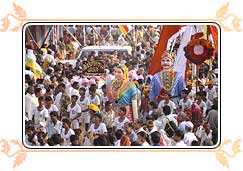
- Tirth
It is in the Ayad Village at a distance of one kilometer from
the city of Udaipur.
- Historicity
There is an inscription that the idol of Bhagawan Adishvar was
installed by Acharya Yashobhadrasurishvarji before the year 1029
of the Vikram era. There is a inscription that in the times of
King Jaysinh in the 13th Century, all the canonical sariptures
were got written on palm - leaves by Shri Hemchandra. The last
renovation of this temple was accomplished in the year 1995 of
the Vikram era. At the time of the renovation, the idol of the
Bhagwan Adishvar was installed.
- Shri Beda Tirth
- Mulnayak
Nearly 65 cms high, black-colored idol of Dada Parshvanath
Bhagawan in the Padmasana posture.
- Tirth
It is in the old Beda village which is at a distance of 5
kilometers from the New Beda village.
- Historicity
On seeing the flow of affection emerging from the body of the
idol of God made of black stone, the worshippers are inspired
with devotion. In the lonely atmosphere of the Arvalli hills, it
is an excellent place for meditation. In many scriptures and
tirthmalas, songs are sung in praise of this tirth. Dada
Parshvanath is also a name of Dokoriya Parshvanath in the tirth
of Chandraprabhas Patan and of Selali Parshvanath of Sesali.
Shining with nine hoods in a new way, the beauty of this idol is
extraordinary .
- Shri Bhandavaji Tirth
- Mulnayak
Nearly 60 cms high, white-coloured, parikarayukta idol of
Bhagawan Mahavir Swami in the Padmasana posture.
- Tirth
It is outside the village, Nana Bhadavpur.
- Historicity
Once upon a time, this was a vast city. This splendid idol
which was installed in the Vesana village on the seventh day of
the bright half of the month of Magasar in the year 813 of the
Vikram era, was reinstalled here in the year 1233 of the vikram
era. This idol is very miraculous. It is said that when people
in power invaded the village Vesana, Sanghvi Palji, a native of
the village took away the idol in a bullock-cart and the
bullock-cart stopped at Bhandva. In a dream Sanghvi got a hint
to build a temple and install an idol. Accordingly the idol was
installed on the auspicious fifth day of the bright half of the
month of Magh in the year 1233 of the Vikram era. Even today,
this place is regarded as a miraculous place. Thousands of Jains
and non-Jains came here to have their wishes fulfilled. A fair
is held here every year from the thirteenth day to the fifteenth
day of the bright half of the month of Chaitra and on the
full-moon day of the month of Kartak.
- Shri Gohili Tirth
- Mulnayak
Nearly 53 cms high,white-colored idol of Bhagawan Godiji
Parshvanath in the Padmasana posture.
- Tirth
It is in the center of the Gohili village.
- Historicity
The ancient name of this tirth was Gohavali. This tirth belongs
to the times earlier than the thirteenth century. There is an
inscription stating that a gift was given here by some Thakor.
It was perhaps renovated from time to time. A fair is held every
year on the tenth day of the dark of the month of Magasar.
|
- Shri Jaislmer Tirth
- Mulnayak
Nearly 105 cms. high, white - colored idol of Bhagawan
Chintamani, Parshvanath in the Padmasana posture.
- Tirth
It
is in the fort on the hill near the Jaislmer town.
- Historicity
Jaislmer is the new capital established by Jesalji after the
fall of Lodrave. The inscription states that the time of the
fall of Ladrava, The idol of Bhagwan Chitamani Parshvanath,
Mulyanak, was installed by Acharya Jinapatisurishvaraji in
Jaislmer in the year 1263 of the Vikram era. The inscription
also states that this idol was installed by Jinvardhansurisvarji
in the year 1473 of the Vikram era. Possibly the idol was
reinstalled after renovation of the temple. This temple was then
named ' Lakhshaman Vihar'. This was a center of Jain religion.
Jaislmer is famous for its distinct art. For its rich collection
of books, Jaislmer is also famous in the country and abroad.
Books on various subjects are stored here. They are very rare.
This is center of special attraction to research workers. There
was an idol of Bhairav near the idol of Parshvanath. Thinking
that is was not proper to seat the servant on the same level
beside Swami, Suriji seated Bhairavji outside the temple. On the
next day, the idol was at the same place. Thinking that
Bhairvaji was an obstinate god, made a very loud in cantation.
The idol itself went and sat outside. The idol of Bhairavaji is
very miraculous. Next to the tirth of Shetrunjaya, this tirth
has such a large number of idols. There is an idol of the size
of an oil - seed in a temple of the size of a grain of barley.
Many rich merchants of this place gained by doing many religious
activities.
- Shri Agra Tirth
- Mulnayak
White - colored idol of Bhagawan Chintamani Parashvnath in the
Padamasana Posture.
- Tirth
It is in the Agra city, which is on the bank of Yamuna river.
- Historicity
This city has an ancient history. There is a mention that it
was in the domain of Emperor Ashok from the year 206 to 166
before the Vikram era. It is mentioned in many tirthamalas that
in the times of Emperor Akbar, Acharya Vijayhirsurishvarji got
many temples installed. This extraordinary idol of Bhagawan
Chaintamaeni Parshvanath was made of Precious stone named yasav.
It was installed here with a great celebration in the year 1639
of the Vikram era. Many honorable rich merchants of the court of
Akbar built here Jina temples and did many religious activities.
Emperor Akbar honored Hirvijaysuri with the designation -
'Jagatguru' and gave him the gift of an invaluable library. Even
today, it is there in the upashraya. This Acharya did many
religious activities, which will be remembered for centuries.
- Ahar Tirth
- Mulnayak
Nearly 550 cms. high, light-rose-colored idol of Bhagawan
Shantinath in the Kayotsarga posture.
- Tirth
It is among the hills near the Ahar village.
- Historicity
This tirth was known as Madaneshpur, Vasuharikpur and
Nandanpur. This is the place of nirvana of the Omniscient
Madankumar of the times of Bhagawan Mallinath. Perhaps that is
the reason why this place is known as Madaneshpur. This is an
ancient tirth in which there were many temples. Even today,
their ruins are found on the hills nearby. Thirty-two castes of
the Jain community, the names of disciples and grand-disciples
of Bhattaraks and the names of disciples and grand-disciples of
Arpyakas are mentioned in the manuscripts here. This idol was
got installed by Sheth Ralhanji during the rule of King
Madanvarma in the year 1237 of the Vikram era. The story goes
that by the touch of this idol, the tin purchased by Shri
Panashah, turned into silver. Even today, many miracles happen
here. A fair is held here every year from the thirteenth to the
fifteenth day of the bright half of the month of Magasar. Many
faithful devotees participate in it.
|
- Shri Calcutta Tirth
- Mulnayak
Nearly 70 cms. high, white - colored idol of Bhagawan
Shitalanath in the Padmasana Posture.
- Tirth
It is in the Sham Bazaar of the Calcutta city.
- Historicity
Rich Jain merchant has largely contributed towards making this
city prosperous and developing it as a chief center of commerce.
These Jain merchants always participated in activities of human
welfare and promotion of religion. Raybhadur Baddidashji, the
son of Lal Kalkadasji, under inspiration of his mother, built
the present artistic temple. He was in search of a distinct
ancient idol. A great man came and indicated to him that in the
sanctuary in the Roshan locality of Agra; there was a wonderful
idol. This idol was thus got. In the year 1867 of the Vikram
era, the idol was installed under the auspices of Acharya
Kalyansurishvarji. This temple is called Baddinath temple or
Parshvanath temple. Every year on the fifteenth day of the
bright half of the month of Kartak, a procession started from
the big temple of Tulpatti and disperses here. It is very
thrilling and delightful. It is believed to be the best in the
whole of India. The Govt. provides all facilities. On that day,
a caste - dinner is arranged in the Dadwadi in front of the
temple.
- Shri Nasik Tirth
- Mulnayak
Nearly 52 cms high, blue coloured idol of Bhagawan Chintamani
Parshvanath in the Padmasana posture and looking beautiful with
seven hoods.
- Tirth
It is in the city of Nasik.
- Historicity
By reading the history of Nasikyapurkalpa written by Shri
Jinaprabhsuri on basis of stories prevalent among Jains and
non-Jains, one gets acquanted with the antiquity and
impressiveness of this tirth. The temple of Chandraprabh Swami
and its ancient idol are not present today but the ancient idols
of Jain Tirthankaras can be seen on the hills near the Chandavad
village at a distance of 45 kilometers from Nasik. The idol of
Mulnayak Chnadraprabh Swami is among them. There is an idol of
Chintamani parshvanath in the temple in the newly settled city
of Nasik on the bank of the Godavari river. It was built by the
sangha about the year 1800 of the vikram era. But according to
another legend , this temple was built in the year 1918 of the
vikram era. But on the cross-legged posture of God, the year
1548 of the virak era is carved. Nearby 30 years ago, the white
idol was coated with blue color. Humming with many large-scale
industries and commercial activities,this city was also a chief
center of religious activities of Jains. Ancient scriptures and
tirthmalas contain prayers to Chintamani Parshvanath.
- Shri Vaishali Tirth
- Mulnayak
Nearly 38 cms high., black-colored idol of Bhagawan Mahavir
Swami in the Padmasana Posture.
- Tirth
It is outside the Vaishali town.
- Historicity
This temple has a very ancient, impressive and glorious
history. It is interwoven with Bhagawan Mahavir Swami. This is
the place of the three Kalyanakas (events beneficent the world)
- chyavan, birth of diksa of Mahavir, according to the Digambar
belief. Once in the past, the city of Vaishali was very
prosperous. The Lichchhvi dynasty was chiefly in power. They
were believed to be Kshtriyas of the Jnatruvamsha. They had
faith in Bhagawan Mahavir. History says that the King of the
Magadhas was fully defeated by the King of Vaishali. The son of
shrenik caused a split in the Vaishali Sangha invaded it and
killed chetak, the King of Vaishali. The glory of the city of
Vaishali came to en end. It was nearly 2000 years old. The Govt.
of Bihar established the Prakrit Jainological and Ahinsa
Research Sansthan. In the whole of India, this institute, the
only one of its type, has a distinct place. It tells the
glorious story of the city of Vaishali.
|