
| Location : | 58-Km From Chennai, Tamil Nadu |
| Also Called: | Mamallapuram, The City Of Bali |
| Famous: | Centre For Pallava Culture And Arts |
| Important Festivals Celebrated: | Dance Festival In The Month Of December |
Mahabalipuram Tour :Globally renown for its shore temples, Mahabalipuram Chennai was the second capital of the Pallava kings of Kanchipuram. 58 kilometres from Madras on the Bay of Bengal, this tiny sea - side village of Mahabalipuram, is set in a boulder - strewn landscape. Tourists are drawn to this place by its miles of unspoiled beach and rock-cut art. The sculpture, here, is particularly interesting because it shows scenes of day-to- day life, in contrast with the rest of the state of Tamil Nadu, where the carvings generally depict gods and goddesses
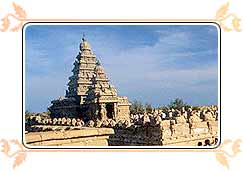
Mahabalipuram art can be divided into four categories : open air bas - relief, structured temples, man-made caves and rathas ('chariots' carved from single boulders, to resemble temples or chariots used in temple processions). The famous Arjuna's Penance and the Krishna Mandapa, adorn massive rocks near the centre of the village. The beautiful Shore Temple towers over the waves, behind a protective breakwater. Sixteen man-made caves in different stages of completion are also seen, scattered through the area.
Mahabalipuram Temple Chennai :History
The temples of Mamallapuram, built largely during the reigns of Narasimhavarman and his successor Rajasimhavarman, showcase the movement from rock-cut architecture to structural building. The mandapas or pavilions and the rathas or shrines shaped as temple chariots are hewn from the granite rock face, while the famed Shore Temple, erected half a century later, is built from dressed what makes Mamallapuram so culturally resonant are the influences it absorbs and disseminates.
All but one of the rathas from the first phase of Pallava architecture are modelled on the Budhist viharas or monasteries and chaitya halls with several cells arranged around a courtyard. Art historian Percy Brown, in fact, traces the possible roots of the Pallavan Mandapas to the similar rock-cut caves of Ajanta and Ellora. Referring to Narasimhavarman's victory in AD 642 over the Chalukyan king Pulakesin II, Brown says the Pallavan king may have brought the sculptors and artisans back to Kanchi and Mamallapuram as 'spoils of war'.
Mahabalipuram Temple
There are, or rather were, two low hills in Mahabalipuram India, about 400m from the sea. In the larger one, on both sides, there are eleven excavated temples, called Mandapas, two "open air bas reliefs", one of which is unfinished, and a third enclosed one. Out of a big rock standing free nearby there is a "cut out" temple, called a "Ratha". This type is unique to Mahabalipuram.
Out of the other hill, much smaller and standing about 200m to the south, are fashioned five more rathas, and three big sculptures of a Nandi, a Loin and an Elephant. On the top of the bigger hill there is a structural temple, and a little distance the magnificent beginnings of a Vijayanagar Gopura and also survivals of what is believed to be a palace.
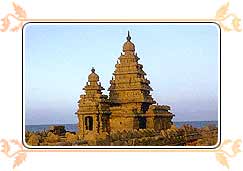 Perched
on a rocky outcrop, it presides over the shoreline, serving, as
Percy Brown puts its, 'a landmark by day and a beacon by night'.
Designed to catch the first rays of the rising sun and to illuminate
the waters after dark, the temple ended up with an unusual lay-out.
As the main shrine faces the sea on the east, the gateway, the fore
count and the assembly hall of the Shore Temple all lie behind the
sanctum.
Perched
on a rocky outcrop, it presides over the shoreline, serving, as
Percy Brown puts its, 'a landmark by day and a beacon by night'.
Designed to catch the first rays of the rising sun and to illuminate
the waters after dark, the temple ended up with an unusual lay-out.
As the main shrine faces the sea on the east, the gateway, the fore
count and the assembly hall of the Shore Temple all lie behind the
sanctum.