
Vrindavan
- The City of Temples
Vrindavan, around 15 km from Mathura, is a major place of pilgrimage, on
the banks of Yamuna . Attracting about 5 lakhs pilgrims every year, it is
noted for its numerous temples- both old and modern. Vrindavan is synonymous
with the innocent mirth and child like playfulness of Shri Krishna.
Vrindavan, the dusty little town known for the temples, big and small,
famous and remote strewn all over the place.
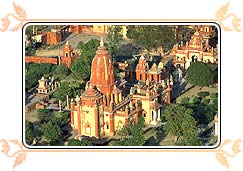
Vrindavana is 135 km south of Delhi and 55 km north of Agra, just off the
Delhi-Agra Road. It is 12 km or a 25-minute auto-rickshaw ride from Mathura.
It has a small-town type atmosphere with narrow streets and not much motor
traffic. There are said to be over 5000 temples in Vrindavana.
Location
Vrindavan is situated in the north Indian state of Uttar Pradesh around 151
km south of Delhi. It extends latitude 27°33¢ in the North to
longitude 77°44¢ in the East. The place is just 10 km off Mathura,
the place where Lord Krishna is said to have spent his childhood. Vrindavan
is situated on the New Delhi-Chennai and New Delhi-Mumbai main railway line.
A meter-gauge line connects Vrindavan to Mathura. There are quite a good
number of passenger trains plying between these two places
History
The name 'Vrindavan' is derived from 'Vrinda', another name for the sacred
tulsi (basil) plant. A legend has it that the entire place was a tulsi grove
at one time. According to another tradition, it was named after Vrinda Devi,
one of Krishna's playmates. The earliest known shrine in Vrindavan is said
to have been built by the local gosains in a large garden called Nidhiban,
later named Seva Kunj. According to tradition, Emperor Akbar was taken
blindfolded inside the grove where he had some kind of a spiritual
experience. As a result, he acknowledged the spot as being holy ground.
The four temples that were built in honour of his visit are Govind Deva,
Madan Mohan, Gopinath, and Jugal Kishore. The first is an impressive edifice
built in red sandstone. Architecturally this temple is one of the finest in
North India.
However, apart from its history, what keeps Vrindavan alive in the popular
imagination of the people is its rich legend and mythology. Vrindavan is
considered the place where Lord Krishna spent his early childhood. It was
here that Krishna indulged in adolescent pranks with the gopis (milkmaids)
in the forests and stealing their clothes while they bathed in the river.
Pilgrimage
Attraction of Vrindavan
- Banke Bihari Temple
This temple was established by Haridas Swami, a contemporary of the
six Goswami's. He discovered the Banke Bihari Deity at Nidhivana,
where Banke Bihari was originally worshiped. Banke Bihari was moved
here when this temple was constructed in 1864. This is the most
popular temple in Vrindavana, especially in the month of Sravana,
during Jhulan Yatra.
The curtain before
the Deities is not left open like at other temples. Every few
minutes the curtain is pulled shut and then opened again. The
Dieties do not get up until 9 am. The temple has mangala-arati only
one day a year. Only one day a year can the lotus feet of the Deity
be seen, on Akhyaya Tritiya.
- ISKCON Temple
HARE RAMA HARE KRISHNA, this name is probably amongst the first
things that spring to a westerner's mind when one thinks of India or
the spirituality connected to it. A.C. Bhaktivedanta Swami
Prabhupada (also known as Srila Prabhupada) established the movement
officially known as the International Society for Krishna
Consciousness (ISKCON) in 1966. The society has since developed into
a worldwide confederation of 6,000 temple devotees and 190,000
congregational devotees. It comprises of more than 350 centers, 60
rural communities, 50 schools and 60 restaurants spread all across
the globe. The aim of the society is to "promote the well being
of society by teaching the science of Krishna consciousness
according to the Bhagavad-Gita and other ancient Vedic scriptures of
India."
- Braja Mandala Parikrama
Every year in Kartika (Oct/Nov) ISKCON puts on a Braja Mandala
parikrama. It is a one-month walking tour that goes to all 12
forests in Vrindavana. The parikarma visits most of major place in
the Braja area including Mathura, Radha Kund, Varsana, Nandagrama,
Gokula, Vrindavana, and Govardhana Hill. It is traditional to do
this walk in bare feet, although shoes are permitted.
- Krishna Balarama Mandir
This beautiful temple has Deities of Gaura-Nitai (left altar),
Krishna Balarama (middle altar), and Radha-Shyama-sundara
(Radha-Krishna on right altar). In front of the temple is the
Samadhi Mandir of His Divine Grace A.C.Bhaktivedanta Swami
Prabhupada, the Founder Acarya of the International Society for
Krishna Consciousness (ISKCON). This is where his body was laid to
rest after he left this world and returned to the spiritual world.
- Yamuna River
This is the most sacred river in Indian. The main reason it is so
sacred is because it flows through Vrindavana and Mathura, and was
thus intimately connected to Lord Krishna's pastimes. One who bathes
in the Yamuna can be purified of all sinful reactions and attain
love of Godhead.
- Kesari Ghat
Lord Krishna killed the Kesi demon here. Kesi Ghat is on the bank
of the Yamuna. If you bath here you get the benediction of bathing
in all off the holy places. There is an arati performed here every
day at sunset.
- Govindaji Temple
This temple was built in 1590 and took several thousand men five
full years to build. The original Govindaji Deity was found about
450 years ago by Rupa Goswami. Govindaji was removed from this
temple when the Muslim emperor Aurangzeb tried to destroy it. The
original Deity is now in Jaipur, in a temple right outside the King
of Jaipur's palace.
This temple was originally seven stories high, with an altar of
marble, silver and gold. A sculptured lotus flower weighing several
tons decorates the main hall. On meeting Rupa Goswami, Man Singh
from Jaipur, a general in Emperor Akbar's army, built this
magnificent temple. Aurangzeb and his army later destroyed part of
the temple. When few stories remained, all of a sudden the ground
began to shake violently and Aurangzeb's men were terrified and ran
for their lives, never to return.
The Deities on the altar in this temple are Govindaji in the
middle, to His left is Lord Caitanya, and to His right is Lord
Nityananda. Below are small Radha and Krishna Deities. Below Them
are Lord Jagannath and a Govardhana-shila.
- Madana Mohana Temple
The original Deity of Madana Mohana was discovered at the base of
an old vat tree by Adaita Acarya, when visited Vrindavana. He
entrusted thje worship of Madana Mohana to His disciple, Purusottama
Chaube, who then gave the Deity to Sanatana Goswami. Sanatana
Goswami spend 43 years in Vrindavana. Worshiped along with Madana
Mohana are Radharani and Lalita, who were sent to Vrindavana by
Purusottama Jena, the son of Maharaja Prataparudra.
This 60 foot high temple was opened in 1580 on a 50 foot hill
called Aditya Tila, next to the Yamuna. Ram Das Kapoor paid to build
the temple. One day a ship he owned, loaded with merchandise, went
aground in the Yamuna. He was advised by Sanatana Goswami to pray to
Madana Mohana for help. The ship came free and the owner of the ship
made a big profit, which he used to built this temple.

- Radha-Damodara Temple
This temple was founded by Jiva Goswami. The main Deities here are
Sri Radha-Damodara. Other Deities worshiped here are the
Radha-Vrindavana Candra Deities of Krishna Dasa Kaviraja Goswami,
the Radha-Madhava Deities of Jayadeva Goswami, and the
Radha-Chalacikana Deities of Bhugarbha Goswami. The original Deities
were all moved to Jaipur. When the original Deities are moved, the
replacement Deity is called a pratibhu-murti and is considered as
good as the original Deity.
- Radha-Gokulananda Temple
In this temple you can see the Radha-Vinod Deities of Lokanath
Goswami, Radha-Gokulananda Deities of Viswanath Cakravarti, Caitanya
Mahaprabhu Deity of Narottama Dasa Thakur, Vijaya Govinda Deities of
Baladeva Vidyabhushana, and the Govardhana-shila given by Lord
Caitanya to Raghunath Dasa Goswami. The samadhis of Lokanath
Goswami, Narottama Dasa, and Viswanath Cakravarti are in front of
the temple. Viswanath Cakravarti arranged to have this temple built.
- Radha-Gopinath Temple
The Deity of Gopinath was discovered at Vamsivat by Paramananda
Bhattacarya, who entrusted the Deity's worship to Madhu Pandita. On
the altar are deities of Srimati Radharani and Her sister, Ananga
Manjari, Madhu Pandita's samadhi is next to the temple.
Gopinathji was originally installed in Vrindavana by Vajranabha,
the great grandson of Krishna. When the Muslims raided Vrindavana,
the original Gopinath Deity was taken to Jaipur. The Gopinath Deity
in Jaipur and Lord Krishna are said to exactly resemble each other
from Their shoulders down to the waist.
- Radha- Raman Temple
Gopal Bhatta Goswami established this temple. The Deity of Sri
Radha-Raman was manifested from one of Gopal Bhatta Goswami's
shalagram-shilas on the full moon day of Vaisakha (April/ May) in
1542. This event is celebrated every year (May) by bathing the Deity
with 100 litres of milk and other auspicious items. The remnants of
this abhiseka (bathing) are like nectar. Gopal Bhatta Goswami's
other shalagram-shilas are worshiped on the altar here. The
appearance place of the Sri Radha-Raman Deity is next to the temple.
Radha-Ramanji is one of the few original Deities of the Goswami's
still in Vrindavana. The standard of worship in this temple is very
high.
- Radha-Syamasundara Temple
These are the Deities of Syamananda Prabhu. Darshan is from 8.30 to
11 am and 5 to 8 pm. It is one of the seven major temples in
Vrindavana. Syamananda's samadhi is across the street and down from
the entrance of the temple.
- Seva Kunja (Nikunjavan)
Krishna would massage Radharan's feet and decorate Her hair with
flowers here. Once Krishna pushed His flute into the ground here and
created a small kund, called Lalita Kund, to satisfy Lalita Sakhi's
thirst. No one is allowed within the enclosure at night. The
numerous monkeys that are there during the day also leave at night.
- Sona Gauranga Temple
These Deities were worshiped by Jagannath Dasa Babaji. They are
located in a person's house next to Prema Talkies cinema in the lane
opposite the Radha Gopinath Temple.
- Gopiswara Mahadeva Temple
The Siva-linga in this temple was installed by Vajranabha, the
great grandson of Krishna. Every morning from 4 am to noon,
thousands of people pour Yamuna water over the linga. It is said
that the big pipal tree here is a kalpavriksya tree and will fulfil
all desires. This temple is in the Vamsivata area.
- Chir Ghat
Krishna rested here after killing the Kesi demon. Lord Caitanya
also rested here. Some people say that the Gopis' clothes were
stolen here by Krishna and other say that this pastime happened 14
km up the river.
- Imli Tala
Sri Caitanya Mahaprabhu would come daily to Imli Tala to chant
japa, when He was living in Vrindavana. Imli Tala means the shade of
the tamarind tree. Imli means 'tamarind' and tala mean 'tree'. There
is a small temple here with Gaura-Nitai and Radha-Krishna Deities.
- Vrindavana Parikrama
It is customary for devotees to walk around the town of
Vrindhavana. There is a parikrama path that goes around the town.
This path is one street over from the ISKCON temple. It takes two or
three hours to go around the town.
|