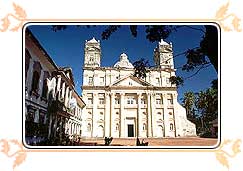
- Basilica of Bom Jesus - Goa
The church of Bom Jesus, "Good" or "Infant"
Jesus, is known principally for the tomb of St. Francis Xavier. In
1946, it became the first church of India to be elevated to the
status of Minor Basilica. One of the richest churches in Goa, it is
covered with marble and inlaid with precious stones and paintings
depicting the life of St. Francis Xavier. The basilica, where the
mortal remains of St. Francis Xavier are kept, is the best specimen
of baroque architecture in India. St. Francis's body was brought to
Goa almost 150 years after his death. It was a gift from Medici,
Cosimo III, the Grand Duke of Tuscany. It now lies in an airtight
glass coffin, placed inside a silver casket fashioned by a 17th
century Florentine jeweller. The chapel attracts large numbers of
visitors every year.
- The Church of St. Cajetan, Goa
The Church of St. Cajetan is modelled on the original design of St.
Peter's Church in Rome. The Church of Bom Jesus with its facade
decorated with Ionic, Doric and Corinthian pilasters, shows the
application of the Classical order. The Se' Cathedral, with its
Tuscan exterior, the Corinthian columns at its portals, the raised
platform with steps leading to the entrance, the barrel-vault above
the nave, is yet another example of Renaissance.
The paintings in the churches were done on wooden borders and fixed
between panels having floral designs as in the chapels housing the
tomb of St. Xavier, the arches above the altars in the transept of
the Se' Cathedral and in the nave on either side of the main altar
in the Church of St. Francis of Assisi. Excepting a few which are in
stone, the statues are mostly in wood delicately carved and painted
to adorn the altars. They depict mostly the saints, Mother Mary and
Jesus on the cross.
- Christ Church & St. Michael's Cathedral, H.P.
The most prominent building on the famous Mall of Shimla is the
yellow Christ Church, reputed to be the second oldest church in
northern India. It still has those lovely stained glass windows for
which it is so famed.
- Church of St Francis of Assisi, Goa
This church is the former palace of the Archbishop that connects
the Se Cathedral to the Convent and Church of St. Francis of Assisi.
The exterior of the Church is of the Tuscan order while the main
entrance is in Manuline style.
To the west of the Se Cathedral is the former palace of the
Archbishop that connects the Se Cathedral to the Convent and Church
of St. Francis of Assisi. The structure is built of laterite blocks
and is lime-plastered. The church faces west and has a nave with
three chapels on either side, a choir, two altars in the transept
and a main altar. To the north of the main altar is a belfry and a
sacristy. The convent, which forms an annexure to the church, now
houses the Archaeological Museum.
- Church of the Sacred Heart, Delhi
Further north, at the south end of Bhai Vir Singh Marg, is one of
Medd's more ambitious projects, the Roman Catholic Church of the
Sacred Heart.
This Church displays a strong Italianate influence, with a facade
of white pillars supporting a canopy set against a dark brick
background, and circular arcades turrets rising above the roof to
each side of the entrance porch. The lofty interior has a towering
curved roof, polished stone floors and broad arches set into smooth
walls, presenting a very grand look.
- Santa Cruz Basilica, Kerala
The Santa Cruz Basilica is a historic church that was built by the
Portuguese. The church was elevated to a cathedral by Pope Paul IV
in 1558 AD. In 1795 AD, it fell into the hands of the British when
they took over Cochin and was demolished.
About a hundred years later, Bishop Dom Gomez Ferreira commissioned
a new building at the same site in 1887 AD. The church was
proclaimed a Basilica in 1984 by Pope John Paul II.
- Cathedral Church of St. Thomas, Mumbai
St. Thomas' Cathedral, the city's first Anglican Church is situated
in the heart of the commercial fort area, in Mumbai . The foundation
was laid in 1672 during the governorship of Gerald Aungier, and was
opened to public on the Chris Ãtmas Day in 1718, and subject
to a number of later additions. Though simple in structure, the
interior of the Church has some exquisite art adoration. A marble
plaque at the front entrance reads: "Let all who enter this
church remember Richard Cobbe, chaplain to the Honorable East India
Company 1715 to 1719, this church had risen to 15 feet when the
building ceased and the site lay desolate for 33 years. It was
consecrated in 1816 and became a cathedral in 1837.
- Little Mount, Chennai (Madras)
Little Mount in Saidapet is where he lived and preached. It is not
much of a hill but high enough for the churches on it to be noticed
form a distance. The new church, consecrated in 1971 attracts
attention by unusual circular shape. However, it is the old church
next door, built in 1711 as extension to shrine which the Portuguese
had built in 1511, that is thronged by pilgrims. It is not
impressive from the outside, but is miniscule interior has an
atmosphere not found in many churches. This Chapel of the Blessed
Sacrament is built against and above the rock cave that was St.
Thomas' home.
|